
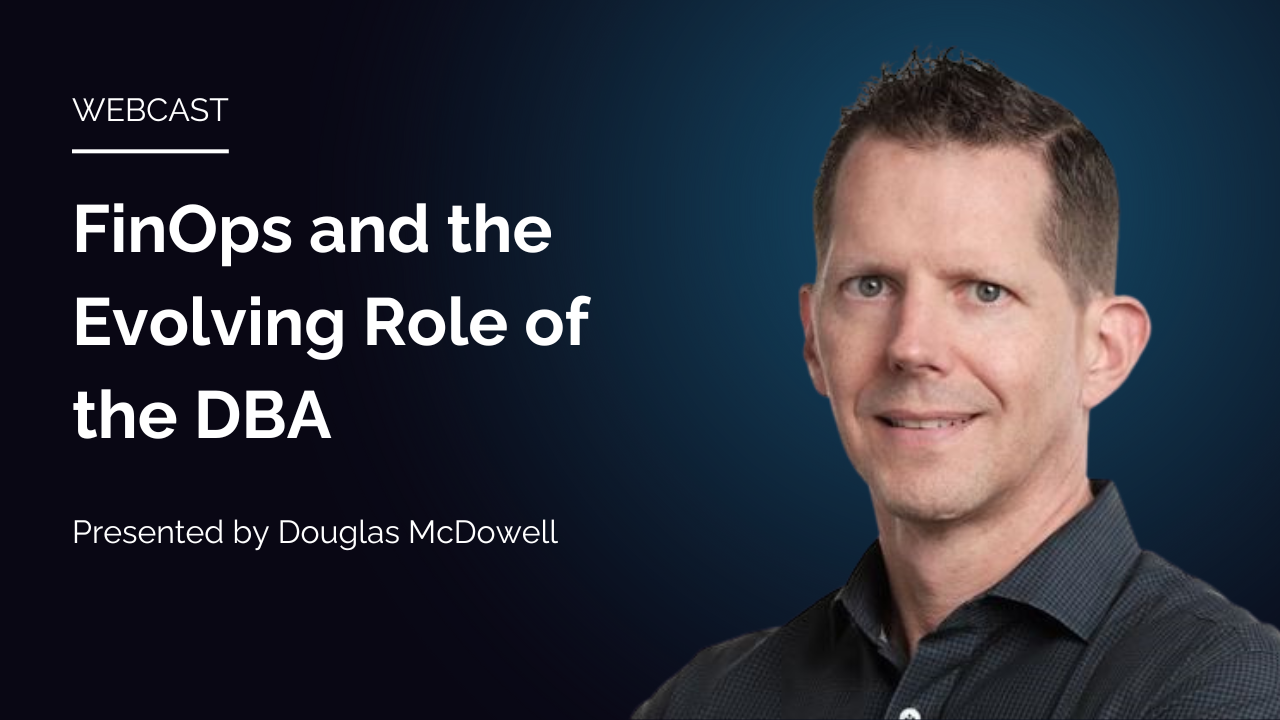
The world of data management is shifting rapidly. For those who have built their careers as database administrators (DBAs) or data professionals, the landscape has changed significantly. The days of isolated database teams operating separately from finance are over. Today, cloud adoption, rising costs, and the introduction of FinOps (Financial Operations) are fundamentally altering how database workloads are managed and optimized.
Douglas McDowell recently explored these critical changes and how database professionals can adapt. His discussion covered the growing importance of FinOps, strategies for managing cloud costs, and practical ways for DBAs to maximize efficiency. Below is a summary of the key insights and takeaways.
For a deeper dive, watch the full recorded presentation below. Douglas explains the evolving DBA role, the impact of cloud costs on traditional database management, and actionable steps for integrating FinOps into daily operations.
DBAs: A Unique Breed of Technologists
Data professionals are often misunderstood. They have always worked in complex environments, leading many to see databases as “black boxes”—important but opaque. This disconnect is particularly evident in the relationship between finance teams and database professionals. In the past, finance leaders questioned the need for expensive servers. Now, in the cloud era, those questions have evolved into concerns about unpredictable cloud costs. And that’s where FinOps comes in.
FinOps: A New Disruptor for Data Teams
Cloud spending is spiraling out of control at many companies, leading to the rise of FinOps—a financial discipline designed to optimize cloud spending while ensuring technology investments create business value. While FinOps is often associated with cloud spend management, its principles apply across all IT environments, whether on-premises, hybrid, or multi-cloud.
Database workloads are among the highest consumers of cloud resources. They require substantial amounts of compute, storage, and network bandwidth—all of which directly impact cloud bills. Every application is ultimately a database application, as applications persist data somewhere.
DBAs Are Uniquely Equipped to Drive FinOps Adoption
With data at the center of cloud consumption, database professionals are in a prime position to lead the charge in optimizing cloud costs. Many organizations still operate under traditional database management models, without incorporating financial awareness into performance monitoring and observability.
FinOps Observability brings cost awareness into database monitoring and ensures that performance metrics align with financial efficiency. DBAs who embrace this mindset will not only run cost-effective systems but also drive more business value, becoming key partners in financial decision-making.
Understanding Cloud Costs: CapEx vs. OpEx
A key takeaway from the discussion was understanding the difference between capital expenditures (CapEx) and operating expenses (OpEx). CapEx involves upfront investments, such as purchasing on-premises hardware, with costs depreciated over time. OpEx consists of recurring expenses, like pay-as-you-go cloud services, billed based on usage.
Cloud services may seem cheaper upfront but often lead to spiraling costs over time, particularly if resources are not managed efficiently. FinOps is not just about cutting costs—it’s about maximizing return on investment and ensuring technology investments align with business goals.
A significant portion of cloud spending—20-30%—is wasted due to inaccurate forecasting, poor optimization, and excessive resource provisioning. Many companies struggle to predict cloud expenses, making it difficult to determine where cost savings can be made. Over-provisioning resources is a common issue, driving up cloud bills unnecessarily.
How DBAs Can Take Action: Code, Copies, and Culture
Three key areas where database professionals can make an impact on FinOps adoption are code optimization, reducing redundant data copies, and fostering a cost-conscious culture.
Code Optimization
A small percentage of database queries drive most of the costs. Identifying and optimizing the most expensive queries can result in significant savings. Real-time cost visibility can help data professionals make better decisions, similar to how fuel efficiency metrics influence driving habits. Code that runs inefficiently today will continue to cost money for years, making SQL tuning a worthwhile long-term investment.
Reducing Redundant Copies of Data
Many companies maintain unnecessary copies of the same database across different environments. Conducting an inventory of redundant data can help eliminate waste. Database bloat is another issue, with indexes, backups, and replications consuming significant storage. The belief that “storage is cheap” often leads to excessive data retention, but in the cloud, storage costs add up quickly.
Creating a Cost-Conscious Culture
DBAs should work closely with FinOps teams to proactively manage costs rather than reacting to finance-driven mandates. Cost efficiency should be embedded in design from the beginning, preventing costly retrofits later. Expanding acceptance criteria for new applications and database workloads to include efficiency and cost impact can lead to long-term savings.
The Future of Database Management in a FinOps World
The role of the DBA is evolving. Data professionals who understand cost implications and proactively manage cloud spending will be at the forefront of this transformation. Structured FinOps programs are growing rapidly, with Gartner predicting that 60% of enterprises will have a formal FinOps practice by 2026.
Organizations that embrace FinOps will not only control costs but gain a competitive advantage. Those that fail to adapt will struggle to keep up as cloud bills continue to rise.
The call to action for data professionals is clear: embrace FinOps now. Whether your company has formally adopted FinOps or not, the principles apply universally. By integrating financial awareness into database management, DBAs can drive better business outcomes, ensure long-term career growth, and become indispensable partners in their organizations.
The future is already here—it’s just not evenly distributed. Taking action now will position you for success in this new era of database management.